Understanding Procrastination First
Before implementing strategies, it helps to understand what procrastination actually is. Dr. Timothy Pychyl at Carleton University has spent decades researching procrastination and has reached a clear conclusion: procrastination is primarily an emotional regulation problem, not a time management problem.
We procrastinate on tasks that trigger negative emotions — anxiety, boredom, self-doubt, frustration, or resentment. When we avoid the task, we get temporary emotional relief. That relief is the "reward" that reinforces the procrastination habit.
This insight is crucial because it tells us what we're actually fighting: we're not fighting laziness, we're fighting the emotional association with the task. The most effective strategies address this emotional dimension directly.
"Procrastination is not a character flaw. It's a habit of prioritizing short-term mood repair over long-term goals. The cure is reducing the emotional cost of starting." — Dr. Timothy Pychyl

The 2-Minute Rule: Remove the Starting Barrier
James Clear's 2-Minute Rule states: if a new habit or task takes less than 2 minutes, do it now. For larger tasks, scale them down to their 2-minute version. The key insight is that starting is almost always harder than continuing.
When you commit to only 2 minutes, you dramatically lower the emotional barrier to entry. Often, you'll find yourself continuing well past 2 minutes because momentum has built. "I'll just write one sentence" becomes an entire page. "I'll just put on my shoes" becomes a full run.
Implementation Intentions: Plan the When and Where
Research by psychologist Peter Gollwitzer shows that implementation intentions — specific plans about when, where, and how you'll perform a task — dramatically increase follow-through rates compared to vague intentions.
Instead of "I'll work on the report this week," try: "I will work on the report on Tuesday at 9:00 AM at my desk for 25 minutes before checking email." The specificity creates a concrete cue that automatically triggers the behavior when the condition is met.
Environment Design: Make Starting Automatic
Your environment shapes your behavior more than your intentions. If your phone is on your desk, you'll check it. If your book is on your desk, you'll read it. Design your environment to make starting the difficult task as automatic as possible.
Techniques: put project files front and center on your desktop, use website blockers during work hours, have a dedicated work space free of distractions, prepare your workspace the night before, and use "friction engineering" to make time-wasting activities harder to access.
Temptation Bundling: Make It Enjoyable
Professor Katherine Milkman's research found that pairing a difficult task with something enjoyable significantly increases completion rates. The formula: only allow yourself to enjoy [WANT] while doing [NEED].
Examples: only listen to your favorite podcast while doing administrative tasks, only watch your guilty-pleasure TV show while filing paperwork, only drink your special coffee while working on the most dreaded project. This transforms something you dread into something you anticipate.
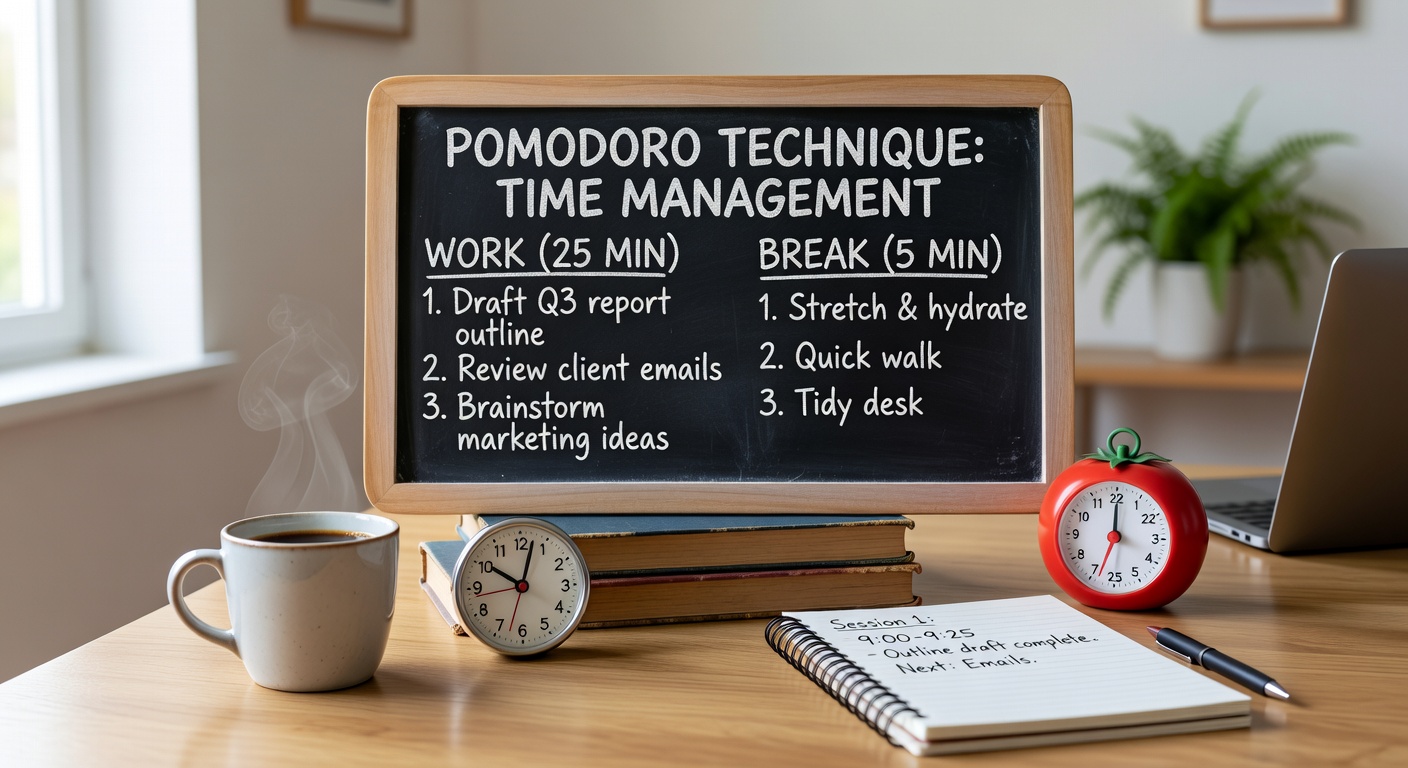
The Pomodoro Technique: Work in Focused Sprints
Developed by Francesco Cirillo in the late 1980s, the Pomodoro Technique is perhaps the most effective procrastination-busting system ever devised. Its power comes from making work finite and predictable, which reduces the emotional weight of starting.
The technique's psychological genius is that 25 minutes feels non-threatening. You can handle anything for 25 minutes. This removes the fear of the endless work session that makes procrastination so tempting.
The standard cycle:
4 Pomodoros = 1 complete cycle. Most people can complete 4-8 cycles per day.
During the 25-minute focus period: no email, no phone, no interruptions. If a thought or task comes to mind, write it down and return to focus. During breaks, genuinely rest — walk away from the screen.
Reduce the Stakes: Give Yourself Permission to Be Bad
Much procrastination is driven by perfectionism. We avoid starting because we're afraid the output won't be good enough. The solution is to explicitly give yourself permission to produce bad work initially.
Write "terrible first draft" at the top of your document. Tell yourself "this is just for me to see." Set a deliberately low standard for the first attempt. Once you've started and produced something — even something terrible — the perfectionism barrier has been crossed, and you can revise from there. You can't edit a blank page.
Process-Oriented Identity: Become Someone Who Doesn't Procrastinate
The deepest fix for procrastination is an identity shift. Instead of "I'm trying to stop procrastinating," adopt the identity: "I am someone who starts tasks immediately." Every time you apply one of these strategies, you cast a vote for that identity.
This works because our brains are highly motivated to maintain consistency with our self-image. When "starting immediately" becomes part of who you are rather than something you're trying to do, the battle becomes much easier. Identity precedes behavior; behavior reinforces identity.